
Welcome to the luffa.info loofah sponge harvest page. Here are photos and videos with step by step descriptions of luffa sponge gourds from the home garden being picked, peeled, and cleaned for use.
When to pick your loofah is the big question. If the skin feels loose and thin like it will come off easily, then it's ready. That is the short answer. The luffa seed pods can hang on the vine until they are crisp and dry but you do not need to wait until the skin gets completely dry. It may be easier to peel them when they still have some moisture. If they stay on the vine until becoming crunchy brown the skin gets brittle and tends to break off rather than peeling. Most loofahs are still good after hanging until crispy dry and there is no question they are done growing. However, the loofahs tend to get darker the longer they hang. If it rains much it is more likely to develop rot or dark spots. If any part turns black from decay then it should be peeled before the whole thing rots. Brown is OK but black is not.
For the fiber to be fully developed you don't want to pick it too soon. Once the green color has started leaving and the weight has decreased, the fiber quits growing. Lift to feel the difference. It should be lighter and the skin should be loose. Anytime after that they can be picked and peeled. If you time it just right the skin will fall off very easily.
If the vines have died from frost the pods have quit developing and should be peeled soon before they begin to decay. If the vines have died off before reaching full maturity there may still be some good fiber, but green hard skin may be much harder to peel. An easy way to test the development of the fiber is by slightly crushing and/or throwing the luffa pod hard at the ground. If there is fiber worth peeling it may crack but will hold together. If it breaks apart, then it wasn't developed enough and belongs in the compost heap. If the skin is very hard then it requires much effort to remove. We crush, slam, and break the skin off to peel them. A hard freeze can break down the skin to make it come off more easily. Some people have baked large hard green ones at 300 degrees for half an hour to soften the skin and make removal easier. Another option is to just let them hang on the vine and see if they dry enough to peel. Often green luffa pods will rot instead of drying so watch closely for decay.
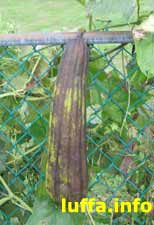
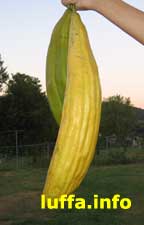 The
first step is to select a loofah that is ready to be peeled. Luffa pods
lose the dark green color and become lighter in weight when ready. Some
varieties go from green to dark brown. Some types turn a yellow or light
brown color. The photos show two different varieties. Sometimes just
being a lighter green signals ripeness. The skin feels loose and thinner
when they are ready to pick. If it feels like it can be peeled easily
then it is ready.
The
first step is to select a loofah that is ready to be peeled. Luffa pods
lose the dark green color and become lighter in weight when ready. Some
varieties go from green to dark brown. Some types turn a yellow or light
brown color. The photos show two different varieties. Sometimes just
being a lighter green signals ripeness. The skin feels loose and thinner
when they are ready to pick. If it feels like it can be peeled easily
then it is ready.
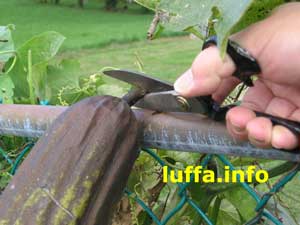 The loofah sponges can be removed by
twisting until the vine breaks. If the vine is still alive it may be
desirable to neatly cut the sponges off in order to minimize damage to
the vine.
The loofah sponges can be removed by
twisting until the vine breaks. If the vine is still alive it may be
desirable to neatly cut the sponges off in order to minimize damage to
the vine.
 Slamming the luffa pod against a hard surface
will knock the skin and seeds loose. Slightly crushing the sponges can
also loosen the skin. This is especially helpful for peeling less mature
loofah with hard green skin. The skin will normally fall off easily if
the loofah is fully mature.
Slamming the luffa pod against a hard surface
will knock the skin and seeds loose. Slightly crushing the sponges can
also loosen the skin. This is especially helpful for peeling less mature
loofah with hard green skin. The skin will normally fall off easily if
the loofah is fully mature.
 The bottom tip of the luffa pod can be broken
off and many seeds can be shaken out before peeling. Banging the loofah
against the inside of a bucket is one way to get them out. Seeds can
also be removed after peeling. Seeds should be allowed to dry for a day
or two before storing so they don't get moldy. Luffa seeds have a thin
clear layer on the outside that comes off after drying. Gently rub and
blow off the seed coating outdoors. As soon as the seeds have dried,
store in a cool place. Refrigerate or freeze in airtight containers for
long term storage.
The bottom tip of the luffa pod can be broken
off and many seeds can be shaken out before peeling. Banging the loofah
against the inside of a bucket is one way to get them out. Seeds can
also be removed after peeling. Seeds should be allowed to dry for a day
or two before storing so they don't get moldy. Luffa seeds have a thin
clear layer on the outside that comes off after drying. Gently rub and
blow off the seed coating outdoors. As soon as the seeds have dried,
store in a cool place. Refrigerate or freeze in airtight containers for
long term storage.
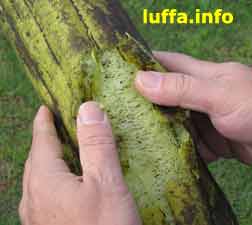 Use your thumbs to find a loose spot along a
seam. Push in to create a tear and pull apart the skin. Tear up the
seam. If the loofah is fully ripe it will come off easily. If not, then
some slamming, crushing, and digging with fingernails may be needed. If
peeling large numbers of loofahs it may be a good idea to wear gloves.
The skin on your hands can become overly exfoliated and sore after
peeling many. Getting the pods wet often makes peeling easier and will
help the skin to separate. If your pods are dry and have hard or brittle
skin then soaking in water for a few minutes will make it much easier to
remove.
Use your thumbs to find a loose spot along a
seam. Push in to create a tear and pull apart the skin. Tear up the
seam. If the loofah is fully ripe it will come off easily. If not, then
some slamming, crushing, and digging with fingernails may be needed. If
peeling large numbers of loofahs it may be a good idea to wear gloves.
The skin on your hands can become overly exfoliated and sore after
peeling many. Getting the pods wet often makes peeling easier and will
help the skin to separate. If your pods are dry and have hard or brittle
skin then soaking in water for a few minutes will make it much easier to
remove.
 Peel the skin
back off one end, usually the top, and pull off the other end. Do
whatever works best for you. After peeling several you'll get a feel for
the best method. Try to get all the skin off as little pieces left
behind tend to turn brown.
Peel the skin
back off one end, usually the top, and pull off the other end. Do
whatever works best for you. After peeling several you'll get a feel for
the best method. Try to get all the skin off as little pieces left
behind tend to turn brown.
 Apply water pressure from a hose
sprayer to remove most of the sap color. It washes out many seeds also.
Washing with soapy water in a bucket and then spraying is another
option. Squeeze and shake out excess water. If your luffa fiber is very
dark, or has many dark spots, soaking in a bucket of water with some
chlorine bleach will remove most stains. It doesn't take much bleach,
maybe one cup for 3 to 5 gallons of water. Don't bleach any longer than
needed. Rinse well. Most loofahs are good with no bleaching. This one
was sprayed with water only and then dried.
Apply water pressure from a hose
sprayer to remove most of the sap color. It washes out many seeds also.
Washing with soapy water in a bucket and then spraying is another
option. Squeeze and shake out excess water. If your luffa fiber is very
dark, or has many dark spots, soaking in a bucket of water with some
chlorine bleach will remove most stains. It doesn't take much bleach,
maybe one cup for 3 to 5 gallons of water. Don't bleach any longer than
needed. Rinse well. Most loofahs are good with no bleaching. This one
was sprayed with water only and then dried.
 The final result is a loofah drying in the
sun. Allow to dry completely. Rotate as needed. The sunlight will
slightly lighten and change the color. Leaving in the sunlight for
longer periods will change the texture of the loofah and make it rougher
feeling. Make sure it is completely dry before storing or mold may grow
on any remaining sap. Store dry loofahs in a bag or box where dust won't
settle on them. They can be kept for years as long as they stay dry and
dust free.
The final result is a loofah drying in the
sun. Allow to dry completely. Rotate as needed. The sunlight will
slightly lighten and change the color. Leaving in the sunlight for
longer periods will change the texture of the loofah and make it rougher
feeling. Make sure it is completely dry before storing or mold may grow
on any remaining sap. Store dry loofahs in a bag or box where dust won't
settle on them. They can be kept for years as long as they stay dry and
dust free.
Copyright 2015 © Luffa.info